Why Umbrellas Flip Inside Out: Wind Physics and Canopy Design Explained
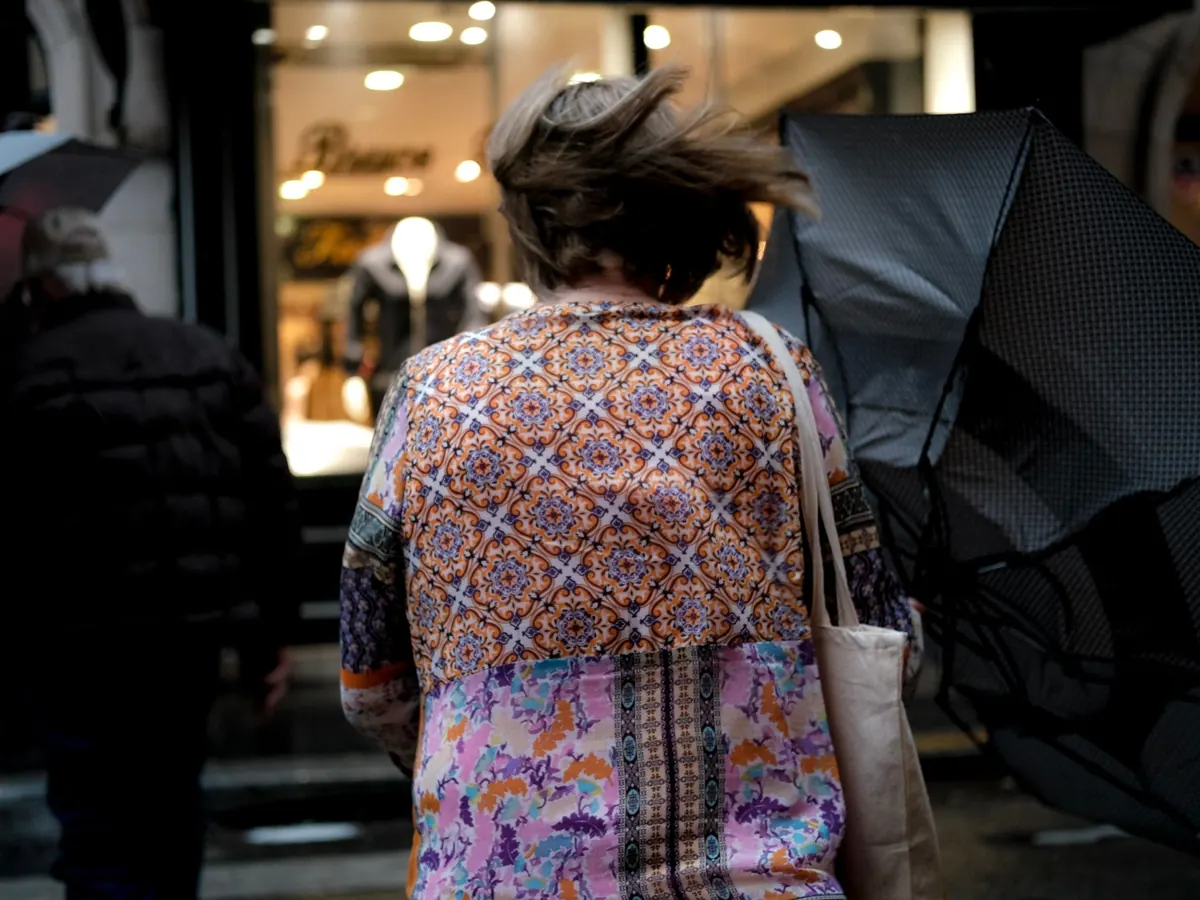
The gust arrives, the canopy buckles, and half a second later the umbrella above your head looks like a collapsed tent on a stick. Anyone who walks in weather has watched it happen — usually from underneath. Inversion isn't bad luck, and it isn't always a cheap umbrella. It's airflow doing exactly what airflow does to a curved surface held at the end of a pole. The difference between a canopy that springs back and one that ends up in a bin comes down to a few design details you can check before you buy.
Understanding the mechanism changes the way you use an umbrella, too. Once you know which direction the air is pushing and why, you can hold the thing at an angle that makes a flip far less likely — and you can tell the difference between a canopy that failed because it was badly built and one that failed because you asked it to stand up to a gale.
Open an umbrella and you have basically raised a sail. Wind meets it as a solid obstacle, and two things happen at once. First, drag: the wind pushes the whole umbrella downwind, which is why you lean into it and your arm aches after ten minutes. Second, lift: air accelerating over the curved top of the canopy drops in pressure, while slower, higher-pressure air gathers underneath. The canopy is an aerofoil pointed the wrong way — a wing that generates force upward instead of holding weight up.
The numbers are small per square centimetre and surprisingly large in total. Dynamic pressure — the energy carried by moving air — rises with the square of speed. At a mild 5 m/s it's about 15 pascals; at 10 m/s it's roughly 60; at 15 m/s it's near 138. Multiply by the 0.7 to 0.9 square metres of a typical canopy, and a brisk 10 m/s gust is already pressing something like 50 newtons onto the fabric — about the weight of a full five-litre bottle of water, applied to the underside of a dome you're holding at arm's length. Push the wind to 15 m/s and you're near 110 newtons. That's eleven kilograms of lift, and no single-handed grip wins that argument.
Note that lift and drag grow together. That's why a strong headwind is worse for your umbrella than a strong tailwind: a tailwind mostly pushes you along, while a headwind attacks the canopy at exactly the angle that produces the most lift.
Angle of attack is the angle between the oncoming airflow and the canopy's chord line — roughly the line running rim to rim across the widest part of the dome. Tip the umbrella forward into the wind and you increase that angle. Up to a point, more angle means more lift. Past that point the airflow separates from the leeward side, the neat pressure difference collapses into turbulence, and the canopy begins to shudder and flutter at the edges.
That shudder is your warning. The upwind rim is the first part to peel, because it has the least structural support and the greatest leverage over the shaft. Once a section of rim lifts, air pours under the canopy like a hand sliding beneath a bedsheet, and the whole thing is on its way over.
So why doesn't the canopy just flop back down when the gust passes? Because the ribs are curved, and a curved structure has two stable states once you push it far enough. Think of a light switch, or the dome of a bicycle bell: push gently and it resists, push past the middle and it snaps through to the other side. That over-centre behaviour is what turns a one-second gust into a permanent inversion.
Cheap umbrellas make this worse in two ways. Thin steel ribs bend plastically at the hinge, so the canopy stays creased even after you wrestle it back; and single-hinge runners are awkward to reset by hand without risking a finger. Better umbrellas use ribs that flex elastically — they bend and spring back — which is why a well-built canopy can invert twice on one walk and still look fine by the time you get home.
The single most effective anti-inversion feature is a hole. A vented canopy has a gap at the crown, or a second smaller canopy floating above the first. High-pressure air trapped underneath has somewhere to escape, so the pressure difference across the fabric — the very thing generating lift — never builds to the level it would on a sealed dome. The effect is dramatic enough to show up clearly in wind-tunnel comparisons, and it shows up just as clearly on a windy walk.
The cost is rain. A vented canopy leaks in heavy, near-vertical downpours, and a double canopy adds weight and a faint rattle overhead. It's a trade, not a free upgrade.
More ribs mean more points of support and a smoother dome that resists local buckling. Eight ribs is the budget standard; sixteen is common on storm umbrellas. Fibreglass and carbon-fibre ribs flex and recover; aluminium is light but fatigues; steel is strong, heavy, and tends to crease. The hinge between rib and stretcher is usually the weakest link, so look for a rivet rather than a crimped bend of metal.
A shallow, flat canopy has less curvature, so it generates less lift — but it also dumps rain off the edges instead of shedding it down the skirt, which is why your shoulders still get soaked. A deep canopy gives better cover and worse aerodynamics. Deep domes with a pronounced skirt catch wind like a parachute and are the classic shape for a dramatic inversion.
Rough Beaufort benchmarks, with the caveat that gusts matter far more than averages — a 40 km/h day routinely delivers 65 km/h bursts at street corners:
Every anti-inversion feature costs you something. Vents leak. Flexible ribs wobble in light wind, which feels flimsy even when it's deliberate engineering. Sixteen-rib storm canopies are heavy, bulky, and a menace on a crowded pavement. And a canopy stiff enough to shrug off Force 7 is usually stiff enough to catch a gust and wrench your wrist instead of gracefully turning inside out — which is not obviously an improvement.
The honest conclusion is that no umbrella beats the physics; some just lose more gracefully. Choose a vented canopy with flexible ribs, hold it tip-into the wind, and when the forecast crosses about 50 km/h, leave it at home.
An umbrella doesn't flip because it's weak. It flips because a curved surface in moving air is a wing — and someone handed you the wrong end of it.
Photo: Mathias Reding / Pexels
Previous Post
How to Repair a Broken Umbrella Rib in 20 Minutes
Next Post
The 10-Point Umbrella Quality Checklist Before You Buy