Clear Umbrellas and Rainy Day Outfits: 5 Photogenic Pairings
A clear umbrella does something no printed canopy can: it keeps you dry while leaving your face, your collar and the colour of your raincoat fully visible. In wet-weather photography that transparency matters more than most people expect. The canopy moves light around instead of blocking it, the ribs draw a tidy arc across the top of the frame, and the person holding the handle still reads as a person rather than a shape under a dome.
What a clear umbrella cannot do is carry the outfit. It is neutral by design, which means every colour decision underneath it gets louder. That is good news if you style for it. Here are five pairings that hold up in the rain, shot on a phone, with wet pavement bouncing light up from below.
Opaque canopies cast colour. A red umbrella tints the skin under it; a black one eats the light around a face and turns a portrait into a silhouette. Clear PVC passes daylight straight through, so whatever light is around you continues to do its job. On an overcast day that means soft, even illumination with no colour cast to correct later.
There are two things to manage. First, reflections: a clear dome catches every streetlight and window, so angle it slightly off-axis from the brightest source rather than squaring up to it. Second, smudges. A clear canopy shows fingerprints the way a dark one never will, so keep a microfibre cloth in your bag and wipe the inside as well as the outside before you start.
All black, all charcoal, or all cream — monochrome plus a clear dome is the most graphic combination available, because the only strong line in the photo becomes the umbrella's rim. Black raincoats and dark denim give you that contrast for free; the risk is a flat, heavy silhouette where the face disappears into the fabric.
Fix it with one lighter element near your chin. Build the outfit from:
For cream and bone monochrome, the clear umbrella almost vanishes against a pale coat. That looks beautiful in soft light and washed out in flat grey, so add a dark bag or dark boots at the bottom of the frame to anchor the image.
Pastel rainwear is the most forgiving thing to photograph in dull weather, because the palette is already desaturated enough to match a grey sky. A mint or powder-pink raincoat under a clear dome looks clean and deliberate rather than washed out — the transparency stops the pale fabric from blending into the clouds behind it.
Keep the rest quiet. White trainers, pale denim, a light knit underneath. Butter yellow and pale lilac work just as well; avoid putting more than two pastels together, or the result turns fussy and slightly childish in photos.
Pastels photograph best in overcast light and worst in harsh midday sun, which bleaches them. Shoot in the hour after rain stops, when the light is soft and the pavement is still dark and reflective. If the whole frame looks pale and low-contrast, darken the edges with something near the camera — a wet bench, a dark coat sleeve, a black handbag resting at your feet.
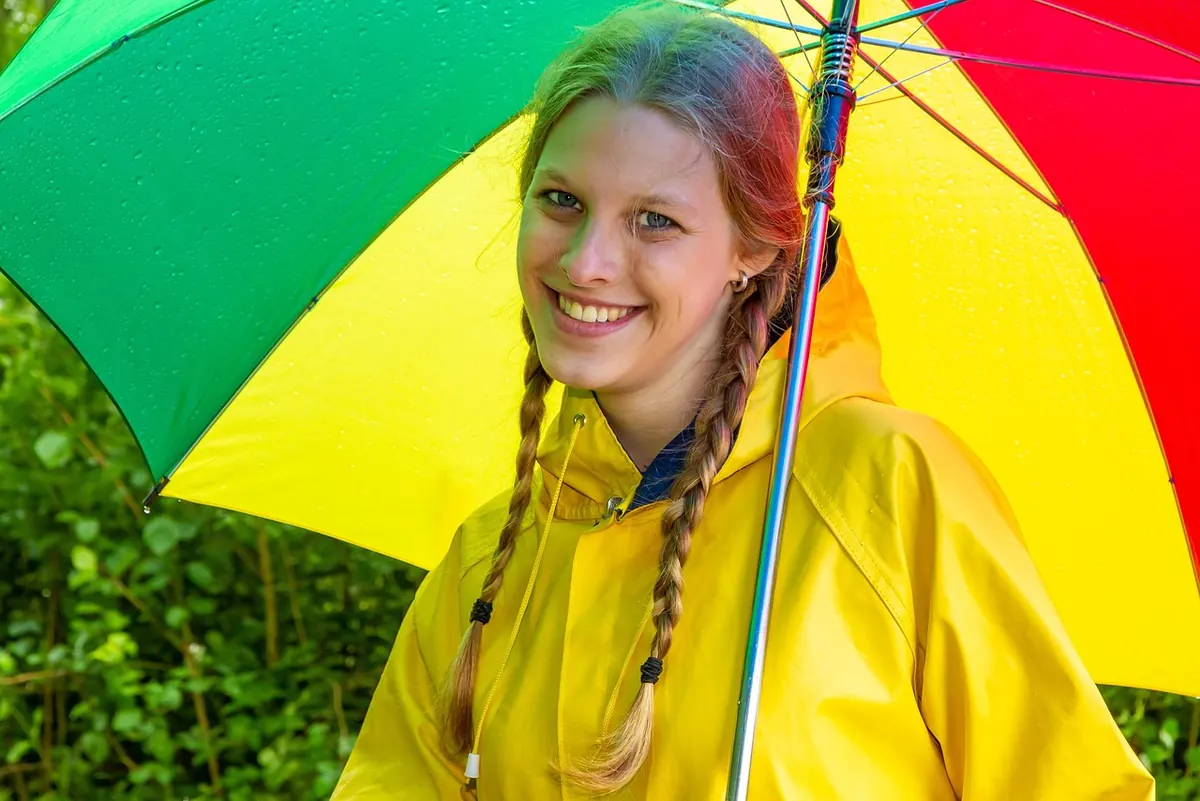
A bright yellow slicker, a tomato-red raincoat, printed PVC, wide checks — loud rainwear needs a neutral frame, and a clear dome is exactly that. The umbrella becomes the picture frame; the coat becomes the subject. Do not fight it with a patterned or coloured umbrella. One statement per outfit is enough.
Bold colour also behaves differently at distance. In a wide shot across a wet street, a yellow coat under a clear umbrella is a single readable shape, which is why this pairing works so well for full-body photos. Step back several metres, put the umbrella high, and let the reflection in the pavement double the colour.
This is the everyday option, and it photographs with a documentary feel that suits street work better than anything polished. Denim darkens when wet and takes on a heavier texture, which reads well next to a thin, transparent canopy. Add a beige mac, a chambray shirt, tan leather boots, a canvas bag.
After dark, wet pavement is a mirror, and a clear umbrella picks up streetlight in a way no fabric can. Wear something that answers it: a silver puffer, a metallic-finish raincoat, satin-finish trousers, patent boots, or a shiny nylon hooded jacket in gunmetal grey. The clear dome catches the same highlights, so the umbrella and the outfit appear lit by the same source.
Timing matters most here. Shoot while the ground is still glossy — that window usually lasts twenty minutes or so after rain stops, and once the pavement dries to a dull matte finish the effect is gone. Position yourself between the camera and a lit shop window, a bus shelter or a row of street lamps, and let the umbrella sit just below the brightest of them.
Pick your pairing based on the light you actually have, not the forecast you hoped for. Monochrome for strong graphic portraits, pastels for soft grey afternoons, statement rainwear when you want colour to carry the shot, denim for candid street work, metallics for after-dark reflections.
Then look after the umbrella itself. Clear PVC scratches and clouds with age, so store it somewhere cool rather than a hot car or a radiator, and shake it open fully before folding. A clear dome that stays genuinely clear is worth more to a photograph than any accessory underneath it.
One practical note on the weather: if a storm brings lightning, high wind or fast-rising water, put the camera away and get indoors. No photograph is worth standing in the worst of it with a metal-ribbed canopy over your head.
Photo: Pexels / Pixabay
Previous Post
Travel Umbrella Buying Guide: What Fits in a Carry-On and Survives Wind
Next Post
Umbrella vs. Rain Hat: Which Gear Keeps You Drier in Heavy Rain?